How Can Small Businesses Compete with Large Corporations on a Limited Marketing Budget?
The challenge is real: 53% of small businesses report struggling to stand out from competitors, and large corporations wield overwhelming advantages in budget, brand recognition, and market penetration. However, the shift to AI-powered marketing and changing consumer preferences
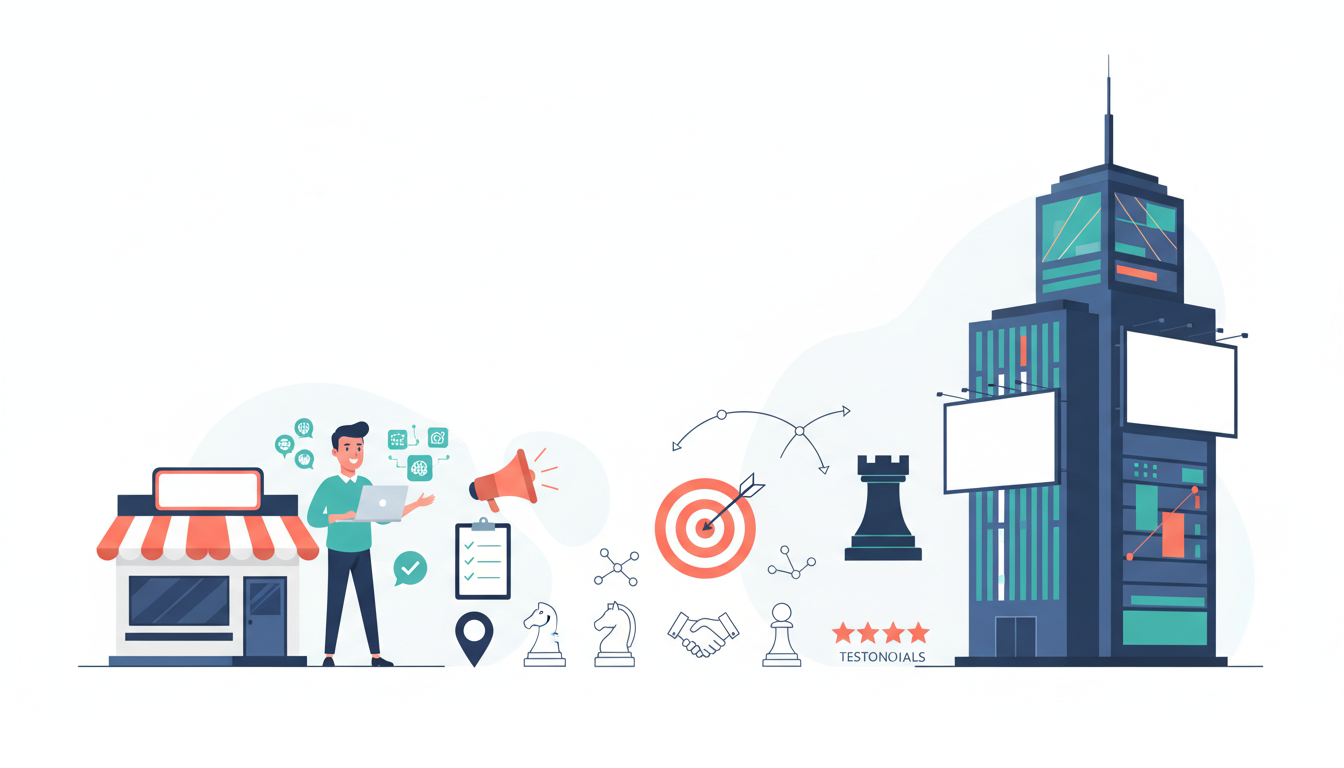
How Can Small Businesses Compete with Large Corporations on a Limited Marketing Budget?
Last Updated: January 16, 2026
Author: Peak Performers Alliance Strategy Team
Read Time: 8 minutes
Can Small Businesses Really Compete with Corporate Marketing Giants?
Yes—small businesses can compete with large corporations by leveraging agility, niche focus, authentic relationships, and AI-powered tools that level the playing field. While you'll never outspend a corporate giant, you can out-strategize, out-maneuver, and out-connect them in ways that deliver superior marketing ROI on a fraction of the budget.
The challenge is real: 53% of small businesses report struggling to stand out from competitors, and large corporations wield overwhelming advantages in budget, brand recognition, and market penetration. However, the shift to AI-powered marketing and changing consumer preferences have created unprecedented opportunities for small businesses to compete effectively.
This guide reveals the specific strategies, tools, and mindset shifts that enable resource-constrained businesses to win customers away from established corporate players.
---
What Marketing Advantages Do Large Corporations Have?
Understanding your opponent's strengths is the first step in developing a winning strategy. Large corporations dominate through four primary advantages:
1. Overwhelming Budget Scale
The financial disparity is staggering:
- 66.3% of small businesses spend less than $1,000 annually on marketing
- 56% of small business owners spend an hour or less per day on marketing
- Large corporations allocate millions to marketing, with dedicated teams for each channel
This budget gap allows corporations to:
- Dominate premium advertising placements (Super Bowl commercials, top Google search results)
- Hire specialized agencies for strategy, creative, and execution
- Afford expensive marketing technology and analytics platforms
- Sustain long-term brand-building campaigns that don't immediately generate ROI
2. Established Brand Recognition
Decades of consistent marketing have built powerful brand equity:
- Consumers already know and trust established corporate brands
- Brand recognition reduces the "convincing cost" of acquiring new customers
- Strong brands command premium pricing and customer loyalty
3. Economies of Scale in Operations
Operational advantages translate to marketing advantages:
- Lower cost per unit allows more aggressive pricing and promotions
- Extensive distribution networks increase market reach
- Large customer databases enable sophisticated segmentation and personalization
4. Specialized Teams and Expertise
Corporate marketing departments operate with deep specialization:
- Dedicated teams for SEO, content marketing, social media, paid ads, email, analytics
- Access to proprietary research and market intelligence
- Established relationships with media and influencers
The Reality Check: You cannot and should not try to compete on these terms. Attempting to outspend or out-scale a corporation is a losing strategy.
---
What Competitive Advantages Do Small Businesses Actually Have?
While corporations have scale, small businesses possess strategic advantages that are impossible to replicate at large organizational sizes. These advantages, when properly leveraged, create sustainable competitive moats.
1. Speed and Agility
Small businesses can pivot in hours; corporations require months. This agility manifests in multiple ways:
Rapid Response to Market Changes:
- When a trend emerges, you can create content and campaigns the same day
- Corporations must navigate approval committees, legal reviews, and brand guidelines
Instant Customer Feedback Integration:
- You can personally read every customer comment and adjust your messaging immediately
- Corporations require formal research studies and analysis before making changes
Testing and Iteration:
- Run a test, analyze results, and implement changes within a week
- Corporations plan quarterly campaigns with minimal mid-flight adjustments
Real-World Example: When a local coffee shop noticed customers asking about plant-based milk alternatives on Instagram, they added oat milk to their menu within three days and promoted it on social media that afternoon. A corporate chain would require months of supplier negotiations, nationwide rollout planning, and marketing campaign development.
2. Authentic Relationships and Personal Touch
Modern consumers increasingly value authenticity over polish. Small businesses excel at building genuine connections that corporate marketing teams cannot replicate:
Direct Owner-Customer Interaction:
- The business owner can personally respond to every email, comment, and review
- Customers feel heard and valued, building loyalty corporations can't buy
Community Integration:
- Small businesses are embedded in local communities with genuine relationships
- 53% of consumers prefer buying from small businesses when possible
Storytelling Advantage:
- Your brand story is real—the struggles, victories, and mission are authentic
- Corporate brand stories are crafted by agencies and feel manufactured
Trust Multiplier—Customer Testimonials:
- Business coach Kadidja Yansane uses video testimonials to build "know, like, and trust" factor, reporting that new clients frequently mention these videos as the deciding factor
- Nick Disney of Sell My San Antonio House attributes direct business to customer testimonial videos that let prospects hear from real previous clients
3. Niche Focus and Specialization
Large corporations target mass markets; small businesses can dominate narrow niches. This focus creates multiple advantages:
Reduced Competition:
- Instead of competing with thousands of businesses for "fitness training," target "postpartum fitness for professional women in Austin"
- Niche targeting dramatically reduces cost per acquisition
Expert Positioning:
- Become the recognized authority in a specific problem, industry segment, or customer type
- Easier to rank in search results and get cited by AI platforms when you own a niche
Higher Conversion Rates:
- Messaging tailored to a specific audience resonates more powerfully
- Customers pay premium prices to specialists who truly understand their unique needs
Market Sizing Reality Check: A "small" niche can support significant business. If only 0.1% of the U.S. population needs your specialized solution, that's still 330,000 potential customers.
4. Lower Overhead Enables Competitive Pricing and Experimentation
Small operational costs create strategic flexibility:
Pricing Flexibility:
- Lower overhead allows competitive pricing without sacrificing margins
- Can offer personalized packages and creative pricing structures
Experimental Capacity:
- Failed marketing experiments cost hundreds, not millions
- Can test new platforms, content formats, and channels before they become saturated
- Early adoption advantage on emerging platforms (TikTok, emerging AI assistants)
---
How Can AI Level the Playing Field for Small Businesses?
Artificial intelligence is the greatest equalizer in marketing history. Capabilities that required entire corporate departments are now accessible to solo entrepreneurs.
AI as the Small Business Competitive Weapon
| Corporate Marketing Function | Small Business AI Solution | Cost Comparison |
|---|---|---|
| Content creation team ($150K+/year) | ChatGPT, Claude, Gemini ($20-200/month) | 99% cost reduction |
| Market research department ($200K+/year) | AI analysis of reviews, competitor content (free-$50/month) | 99.9% cost reduction |
| 24/7 customer service team ($100K+/year) | AI chatbots and automated FAQ ($30-100/month) | 99% cost reduction |
| Email marketing specialist ($80K+/year) | AI-powered email platforms with automation ($50-200/month) | 99% cost reduction |
| Ad optimization team ($150K+/year) | Automated bidding and audience insights (built into ad platforms) | Included in ad spend |
Practical AI Applications for Competitive Advantage
1. AI-Powered Content Creation at Scale
- Generate blog posts, social media content, email newsletters, and product descriptions in minutes
- Maintain consistent brand voice across all channels
- Produce 10x more content than corporations expect from a small business
Implementation: Use ChatGPT or Claude to create content outlines, first drafts, and variations. Edit for accuracy and brand voice. A single owner can now produce content that previously required a full team.
2. AI-Optimized Visibility in Answer Engines
- Structure your content to be cited by ChatGPT, Gemini, Claude, and Perplexity
- Corporations are slow to adapt to AI platform optimization—you can move faster
- Become the authoritative source AI platforms reference when users ask questions in your niche
Implementation: Use question-based headings, answer capsules, structured data markup, and comprehensive coverage of niche topics. (Peak Performers Alliance specializes in this exact strategy.)
3. Hyper-Personalized Customer Experiences
- AI analyzes customer behavior to deliver personalized recommendations
- Automated email sequences triggered by specific customer actions
- Chatbots that answer questions instantly, 24/7
Implementation: Implement AI chatbots on your website (Tidio, Intercom, Drift start under $50/month). Use AI-powered email platforms (Klaviyo, ActiveCampaign) to segment audiences and personalize messaging.
4. Competitive Intelligence and Market Research
- AI tools scrape and analyze competitor websites, pricing, and messaging
- Sentiment analysis of customer reviews reveals gaps in competitor offerings
- Trend identification from social media and search data
Implementation: Use AI to analyze your top 3 competitors' websites and identify what they're missing. Create content and services that fill those gaps.
---
What Are the 5 Core Strategies to Compete with Limited Budgets?
Strategy 1: Own Your Niche with Content Authority
The Approach: Instead of competing broadly, become the undisputed expert in a narrow niche through comprehensive, authoritative content.
Action Steps:
- Identify Your Niche: Define the specific problem, industry, or customer type you serve better than anyone else
- Create a Content Hub: Publish 20-30 in-depth articles (1,500+ words each) answering every question your niche customers ask
- Build Topic Clusters: Interlink related articles to signal topical authority to search engines and AI platforms
- Get Cited by AI: Structure content with question-based headings, answer capsules, and schema markup
Why It Works: Google and AI platforms prioritize demonstrated expertise. A small business with 30 comprehensive articles on "commercial HVAC maintenance for food processing plants" will outrank a Fortune 500 HVAC company with generic content.
ROI Timeline: 6-12 months to see significant organic traffic; 18-24 months to achieve market-dominating authority
Strategy 2: Leverage Customer Advocacy and Social Proof
The Approach: Turn satisfied customers into your marketing department through testimonials, case studies, and referral programs.
Action Steps:
- Collect Video Testimonials: Ask every satisfied customer for a 60-90 second video testimonial
- Create Detailed Case Studies: Document the problem, solution, and measurable results for 3-5 ideal customer examples
- Display Social Proof Everywhere: Add testimonials to your website homepage, Google Business Profile, social media, and email signatures
- Implement Referral Incentives: Offer customers a valuable incentive for referring new business
Why It Works: Modern consumers trust peer recommendations more than corporate advertising. Testimonials deliver 36:1 ROI potential, higher than nearly any paid advertising channel.
Cost: $0-500 (minimal video equipment or editing software)
Strategy 3: Dominate Local and Niche Search
The Approach: While corporations compete for broad, expensive keywords, small businesses can own high-intent local and niche searches.
Action Steps:
- Optimize Google Business Profile: Complete every section, post weekly updates, collect reviews, add photos
- Target Long-Tail Keywords: Instead of "accounting services" ($50+ per click), target "tax preparation for real estate investors in Denver" ($2-5 per click)
- Create Location-Specific Content: Publish articles optimized for "[your service] in [your city]" searches
- Build Local Backlinks: Partner with local businesses, join chamber of commerce, sponsor community events
Why It Works: 46% of Google searches have local intent. Local searches have higher conversion rates and lower competition than national keywords.
ROI: Immediate for Google Business Profile optimization; 3-6 months for local SEO content
Strategy 4: Build Community, Not Just Audience
The Approach: Create a engaged community of customers and prospects who interact with each other, not just with your brand.
Action Steps:
- Choose One Community Platform: Facebook Group, LinkedIn Group, Discord server, or email-based community
- Provide Exclusive Value: Share insights, templates, and resources not available elsewhere
- Facilitate Peer Connection: Encourage members to help each other, creating network effects
- Show Up Consistently: Engage daily, answer questions, and spotlight member wins
Why It Works: Communities create switching costs that corporations can't match. Members develop loyalty to the community and the brand that facilitates it.
Real-World Example: A marketing consultant built a free Slack community for e-commerce founders, providing daily tips and facilitating peer support. After 18 months, the community had 2,000 members and generated $500K in consulting revenue—zero ad spend.
Strategy 5: Strategic Partnerships and Co-Marketing
The Approach: Partner with complementary businesses to share audiences, resources, and credibility.
Action Steps:
- Identify Complementary Businesses: Who serves the same customer but doesn't compete with you?
- Propose Win-Win Collaborations: Joint webinars, content bundles, cross-promotions, package deals
- Leverage Each Other's Audiences: Guest appearances on podcasts, email list swaps, social media takeovers
- Create Referral Agreements: Formal or informal agreements to refer customers to each other
Why It Works: Partnerships give you instant access to established, relevant audiences without paid acquisition costs.
Example: A wedding photographer partners with wedding planners, florists, and venues. Each business refers clients to the others, creating a trusted network that competes effectively against large wedding service marketplaces.
---
What Should Small Businesses Stop Doing When Competing with Corporations?
Equally important as what to do is what to avoid. These common mistakes waste limited resources and ensure failure.
Stop Trying to Compete on Corporate Terms
Don't:
- Try to outspend corporations on broad, competitive keywords
- Compete on price alone (corporations have economies of scale you can't match)
- Attempt to build brand awareness through mass media (TV, radio, billboards)
- Spread your limited budget across every marketing channel
Instead:
- Focus on niche keywords where you can dominate
- Compete on value, expertise, and personalized service
- Build awareness through owned channels (content, email, community)
- Master 1-2 channels before expanding
Stop Imitating Corporate Marketing Tactics
Don't:
- Copy corporate messaging and positioning (you'll always be a discount version)
- Chase every trend and platform corporations are using
- Prioritize polish and production value over authenticity
Instead:
- Develop unique positioning based on your specific strengths
- Be an early adopter where corporations are slow (AI platform optimization)
- Embrace authentic, behind-the-scenes content that shows your humanity
---
Frequently Asked Questions About Competing with Large Corporations
What if a large corporation enters my niche market?
When a corporation enters your niche, they validate the market opportunity—that's good news. Your response: double down on what makes you different. Emphasize your specialized expertise, personal service, local presence, and customer relationships. Corporations excel at "good enough for everyone" but struggle to deliver "exceptional for a specific someone." Position yourself as the specialist vs. their generalist approach. Many small businesses thrive alongside corporate competitors by serving customers who value expertise and personalization.
Can small businesses compete in markets dominated by Amazon, Walmart, or other giants?
Yes, but not on their terms. Compete through specialization, curation, expertise, and experience rather than selection and price. A small outdoor gear shop cannot compete with Amazon's 5 million products, but it can dominate "ultralight backpacking gear for thru-hikers" with expert staff, curated selection, and a community of passionate customers. Focus on underserved niches, exceptional service, and building relationships that marketplaces cannot replicate.
How much budget do I realistically need to compete?
You need enough budget to consistently execute a focused strategy for 12-18 months. For most small businesses, $500-2,000 per month invested strategically delivers competitive results. The key is concentration—invest deeply in 1-2 channels where your customers are rather than spreading $2,000 across 10 different tactics. Many successful small businesses compete effectively with $0 ad spend by focusing on organic content, email marketing, community building, and customer advocacy.
Is it better to compete locally or try to compete nationally/globally?
Start local or niche-specific, prove your model, then expand. Local competition is less intense, cost per acquisition is lower, and you can leverage local SEO, community relationships, and geographic advantages. Once you dominate locally, expand to additional geographic markets or niche segments with a proven playbook. Attempting to compete nationally from day one spreads resources too thin and prevents building the concentrated authority needed to win.
---
Your Competitive Action Plan: 90 Days to Small Business Marketing Advantage
Days 1-30: Focus and Foundation
- [ ] Define your specific niche (narrow is better)
- [ ] Research and document your top 3 corporate competitors' weaknesses
- [ ] Optimize your Google Business Profile completely
- [ ] Collect 5-10 customer testimonials (video preferred)
- [ ] Create detailed buyer personas
- [ ] Choose your 1-2 primary marketing channels
Days 31-60: Content and Authority
- [ ] Publish 8-10 comprehensive blog posts answering customer questions (AI-optimized structure)
- [ ] Set up AI chatbot for 24/7 customer service
- [ ] Launch email nurture sequence
- [ ] Identify 3-5 potential strategic partners
- [ ] Create first case study showcasing results
Days 61-90: Community and Scale
- [ ] Launch community platform (Facebook Group, LinkedIn Group, or email-based)
- [ ] Implement referral program
- [ ] Establish partnership agreements with 2-3 complementary businesses
- [ ] Begin consistent content publishing schedule (weekly minimum)
- [ ] Measure and optimize based on ROI data
---
How Peak Performers Alliance Helps Small Businesses Compete and Win
The playing field is more level than it's been in decades—but only for small businesses that understand how to leverage their unique advantages and AI-powered tools strategically.
Peak Performers Alliance specializes in helping resource-constrained businesses compete with corporate giants through AI platform optimization. Our strategies are built specifically for businesses that can't outspend competitors but can out-strategize them.
What We Do Differently
AI-First Marketing Strategy: We optimize your content and digital presence to be discovered and cited by ChatGPT, Gemini, Claude, and Perplexity—the platforms where your customers are increasingly finding solutions.
Niche Domination Playbooks: We help you identify and own specific market niches where you can become the recognized authority, making corporate competition irrelevant.
High-ROI, Low-Budget Tactics: Every strategy we recommend is filtered through one question: Can this deliver measurable ROI with limited resources?
Ready to stop competing on corporate terms and start winning on your own? Visit [Peak Performers Alliance](https://peakperformersalliance.com) to discover how AI-optimized marketing strategies can transform your small business into a formidable competitor.
---
About the Author: The Peak Performers Alliance Strategy Team has helped hundreds of small businesses develop competitive advantages against larger competitors through AI-powered marketing, niche positioning, and community-building strategies.
Ready to Boost Your AI Visibility?
Let's discuss how these strategies can drive growth for your small business.